

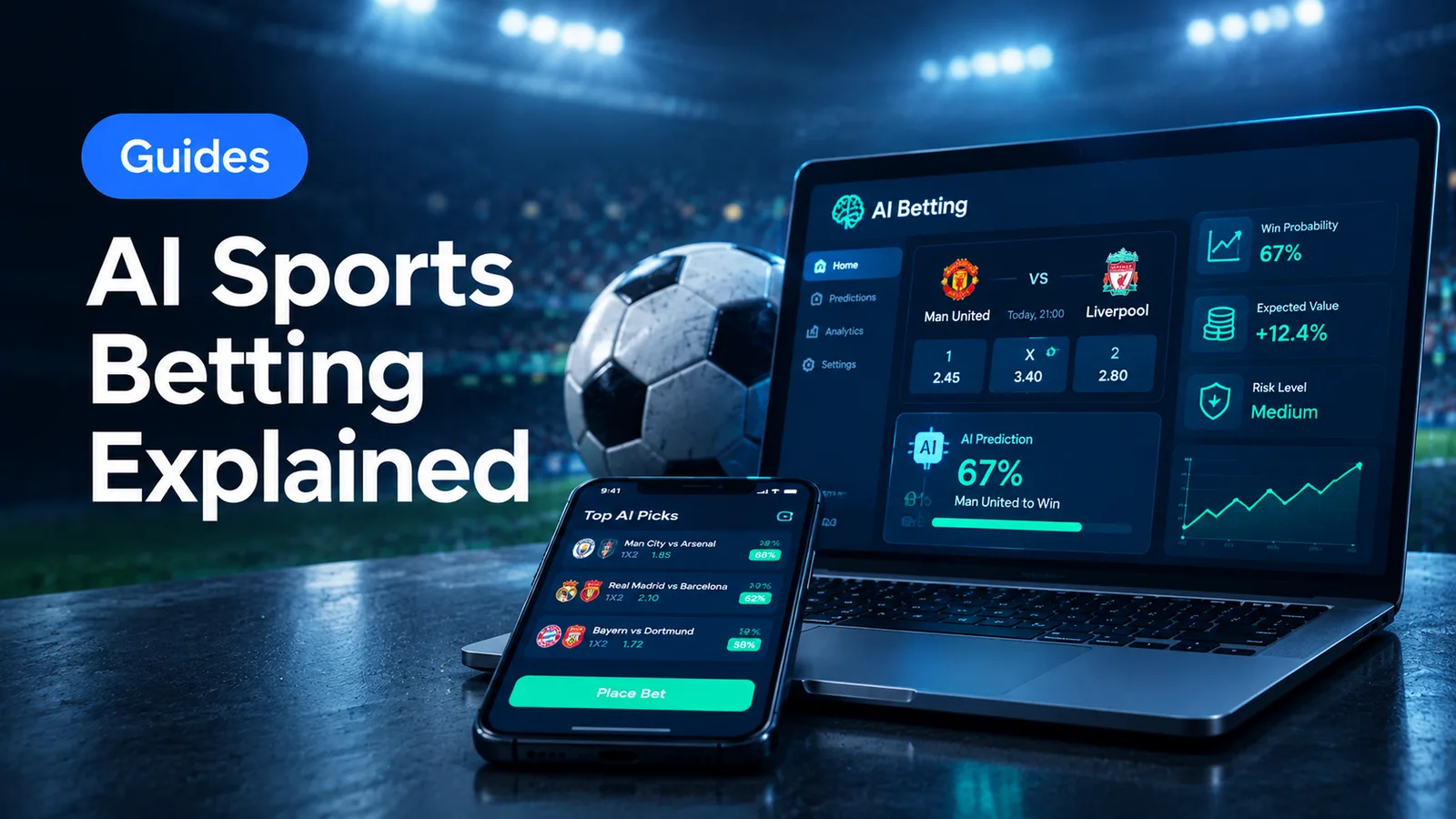
AI Sports Betting: What It Is and How It Works
AI sports betting has moved from a niche hobby of quantitative bettors to something anyone can open on a phone. The label covers a wide range of tools, from serious probability models to apps that mostly repackage a coin flip with a confident tone. This guide explains what these systems actually do, where they work, where they fall apart and how to judge one before you trust it. It is written for readers who already look at AI predictions and want to understand what sits behind the percentages.
What Is AI Sports Betting
AI sports betting is the use of statistical and machine learning models to estimate the probability of a sporting outcome, then compare that estimate with the price a bookmaker offers. The model does not "know" who wins. It produces a probability, for example a 45% chance of a home win, and that number is only useful next to a market price.
The comparison is where the betting logic starts. Bookmaker odds convert into implied probability (the chance the price suggests, before the bookmaker's margin is removed). If a model rates an outcome as more likely than the odds imply, the bet may have positive expected value, but only if the estimate is reliable enough to hold up against the bookmaker's margin, model error and gaps in the data. A small difference between model and market can easily be noise. Value betting looks for gaps of this kind, which is why the estimate itself has to be tested. If the model and the market agree, there is nothing to find. Plenty of AI sports betting apps skip the comparison entirely and only show a predicted winner, which tells you very little on its own.
It also helps to be clear about what AI sports betting does not cover. A model is not a source of inside information, and it cannot see anything its data does not contain. A late injury, a sudden change of manager or a team resting players before a cup final can all move the real probability, and a model only reflects them once that information reaches its inputs. AI output is best read as a structured starting point for your own judgment.
How AI Sports Betting Models Work
Most models follow the same three-stage chain: collect data, turn it into a probability, compare the result with the line. Details differ between providers, so a claim about the best AI tools for sports betting says little until each stage has been checked.
The data stage pulls in results, lineups, schedules and match statistics. In football, a common ingredient is xG (expected goals, a measure of shot quality that estimates how many goals a team should have scored). The probability stage then feeds those inputs into a model. Typical families include:
- rating systems such as Elo, which update a strength score after every match;
- Poisson-based models, which use expected goals to estimate the chance of each scoreline;
- machine learning (ML) models, which learn patterns from large historical datasets.
The last stage compares the output with market odds, which is where the model's number becomes a betting signal. Anyone looking for the best AI for sports betting is effectively comparing the quality of these three stages: how clean the data is, how well the probabilities are calibrated, and how carefully the comparison with the market is done. A more elaborate algorithm cannot make up for weak inputs, and results vary by league, sample and method.
Good data-driven predictions also come with uncertainty. A model that says 52% is admitting the match is close, and a single result never proves it right or wrong. A large sample is needed to see whether those percentages hold up. The comparison step needs care too. Bookmaker odds include a margin, so the implied probabilities across all outcomes add up to more than 100%. A careful system removes or accounts for that margin before measuring any gap, otherwise it can report value that is not there. The size of an apparent gap says little by itself. What matters is whether gaps of that kind have held up across many matches.
Nothing in this process promises a return. Which AI is best for sports betting depends on the league, the sample and the method behind the estimates, and the outputs remain estimates.
Sports Where AI Works Best
Models need data. A sport with many recorded matches and events gives a model more to learn from, although more data does not guarantee a better forecast, since data quality and the amount of randomness in the sport matter as well. Football, tennis and basketball are among the sports with extensive data coverage, so sports betting AI generally has more to work with there, though forecast quality still varies by league, market and method.
Football has deep leagues, years of results and widely used shot-quality data, even though low scoring makes any single match hard to call. Tennis generates many matches per season, while surface, player form and match-specific statistics provide useful inputs for modelling. Basketball produces a high number of scoring events per game, which can reduce the influence of single-event randomness compared with football, though schedule effects and roster changes still matter.
The picture gets worse as data thins out. Small leagues, lower divisions and rare tournaments offer short histories, patchy statistics and more surprises from lineup or motivation changes. A model can still output a number there, but the number rests on much less evidence. Forecasts from sports betting AI in those settings deserve extra caution, and the uncertainty is typically wider than for a major league.
Timing is another limit for sports betting AI. A model that relies on confirmed lineups can only finalize its view shortly before kickoff, while earlier estimates lean on expected lineups and carry more uncertainty. A service that states which version of the information a prediction used makes this easier to judge, and it is worth checking before comparing a prediction with a price.
Common Misconceptions
Four beliefs come up repeatedly around sports betting AI tools, and each one is misleading.
- "AI gives a 100% guarantee." No model can remove the randomness of sport. Even a well-calibrated tool will still get many individual predictions wrong.
- "ChatGPT will predict the winner." A general-purpose chatbot is built to produce fluent text. By default it has no live feed of injuries or lineups and no track record as a calibrated forecaster, so its confident answer is not a probability model.
- "Bots beat the bookmaker." Bookmaker prices already contain a lot of information, and they carry a margin. Some sports betting AI tools can flag prices that look off, but beating the market over time is hard and not automatic.
- "More complex means more accurate." A simple, well-fitted model with good data often does better than a complicated one trained on noise.
Each of these myths treats a prediction as a verdict. A probability of 70% still means the other outcome happens roughly three times in ten, and over a short run of bets that result is common.
A better model can produce better estimates, but it cannot remove uncertainty from the underlying event. Sports betting AI tools that speak in certainties deserve suspicion.
How to Evaluate an AI Betting Service
When choosing AI for sports betting, it helps to check a service against five criteria. A fuller framework is laid out in our guide to the criteria for a good AI prediction site.
- Methodology. Look for a service that explains, at least in broad terms, what data it uses and what kind of model produces the numbers. A black box with no description makes the output harder to assess.
- Tracking. Look for a public, verifiable history of past predictions, recorded before the matches. Screenshots of selected winning picks are weak evidence.
- Calibration. When a tool says 60%, outcomes like that should happen roughly 60% of the time over a large sample. Accuracy on a handful of picks says little.
- Market coverage. Wider coverage, such as 1X2 (home win, draw, away win), Over/Under 2.5 goals and BTTS (both teams to score), shows how a service performs across different questions. A narrow focus is not a flaw if the service is open about it.
- Free access. A free tier or trial makes it easier to test the output against real matches yourself before paying anything. It is not evidence of quality on its own, and paid-only services can be reliable too.
No service is likely to score perfectly on all five. Prefer tools whose claims can be checked. With AI for sports betting, every number is an estimate and every track record needs verifying.
Finally, look at how a service talks about its own misses. It is a good sign when a provider of AI for sports betting publishes losses alongside wins and documents model changes. A provider that only shows successes is presenting a selection of results, not a full record.