

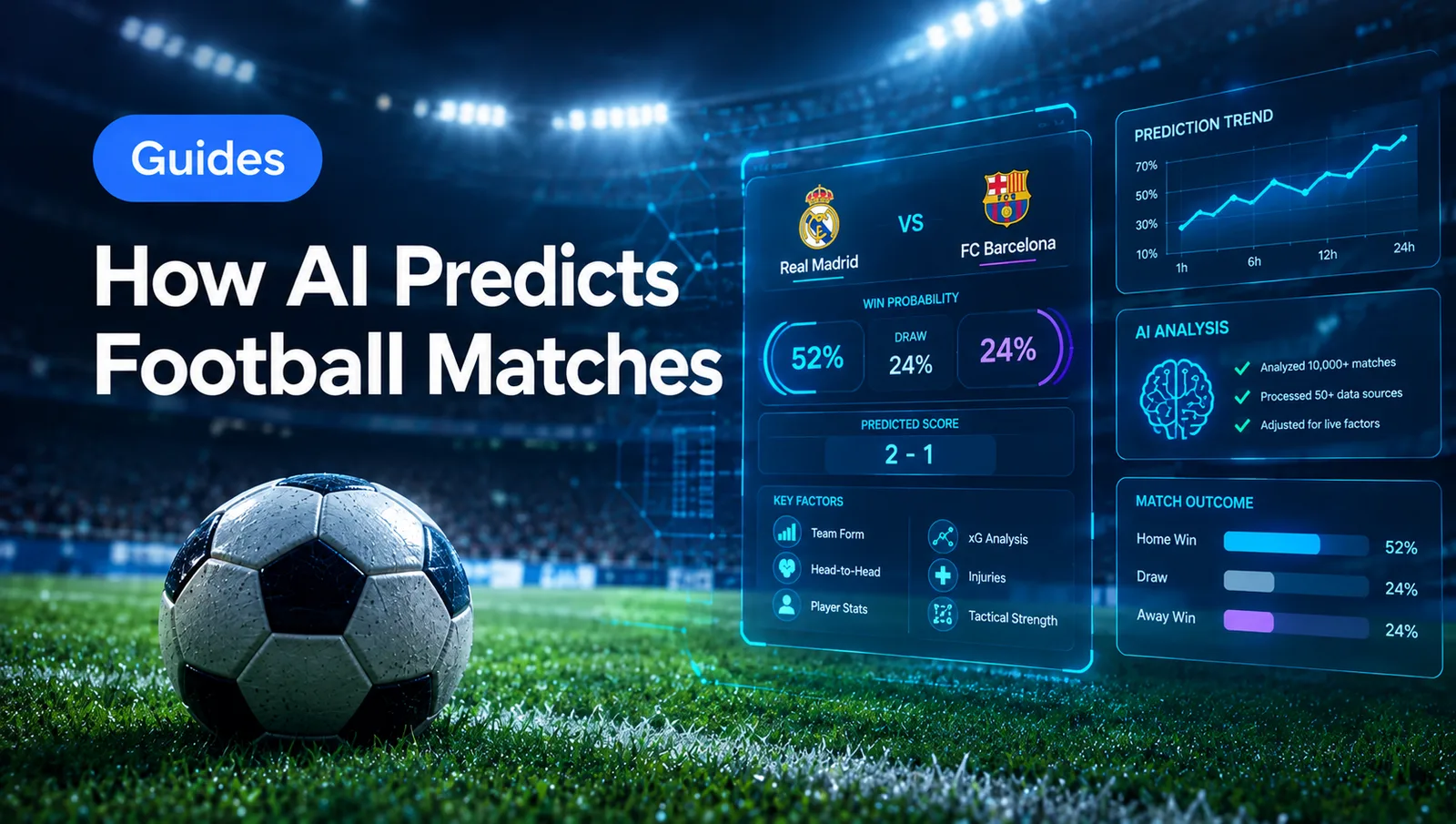
How AI Predicts Football: The Complete Methodology
Every weekend, thousands of football matches get played, and every one of them has a price attached. Somebody set that price. Increasingly, that somebody is a model: a piece of software that has chewed through years of match data and learned what tends to happen when a certain kind of team meets another.
This guide walks through how that process works at Oddscore, step by step: what goes into a model, how several simple models get stitched into one probability, where machine learning earns its keep, and what accuracy you can honestly expect. No hype, no magic formulas, just the mechanics.
One thing to settle upfront: AI in football forecasting is a broad label. Behind it sit fairly old statistical tools, modern machine learning, and a lot of careful data cleaning. The clever part is rarely one algorithm. It's how the pieces fit together, and how honestly the output gets tested.
What Is AI Football Prediction
An AI football prediction is a probability for a match outcome, calculated by a model trained on large volumes of historical data. Instead of saying Arsenal will win, it says Arsenal win in 58% of simulated versions of this match, draw in 24%, lose in 18%.
That is the key difference from a tipster. A tipster gives you a pick, usually with a story attached. A model gives you a number, and the number can be checked against the market, tracked over hundreds of matches, and proven right or wrong at scale. It has no favourite club, no hangover, and no memory of the last bet that burned it.
It also updates constantly. A tipster forms an opinion on Tuesday and sticks with it. A model reprices the moment new information lands, whether that's a late injury, a lineup leak, or a sharp move in the odds.
The Data That Feeds an AI Model
Any AI prediction for football is only as good as its inputs. A typical model pulls from these groups:
Match results. Scores, home and away splits, head-to-head history across several seasons.
Shot data and xG. The quality of chances created and conceded, shot by shot.
Recent form. Rolling performance over the last 5–10 matches, weighted toward the newest games.
Squad information. Confirmed lineups, injuries, suspensions, rotation patterns.
Schedule context. Rest days, travel, congested fixture runs, cup distractions.
Team strength ratings. Long-term power scores such as Elo that update after every result.
Market odds. Bookmaker prices, which carry the collective opinion of thousands of bettors.
Some models add weather, referee tendencies, or manager changes. These help at the margins, but the core groups above do most of the heavy lifting.
Match Data and Form
A league table tells you where a team finished after 38 games. It says very little about what the team looks like right now. A side sitting eighth can be the best-performing team in the division over the last two months, and the table will take weeks to catch up.
That is why models lean on rolling xG and form windows of 5–10 matches. Expected goals measure chance quality, which is far more stable than actual goals. A team can lose 1–0 three times in a row while creating 2.0 xG per game, and a good AI prediction football model will read that as bad luck with a strong underlying process, not as a crisis.
Weighting matters too. A match from last week says more than one from last season, so older data fades out gradually instead of being cut off at a hard line.
Home and away splits get the same treatment. Some teams are fortresses at home and ordinary on the road, others barely notice the difference. Averaging both together hides exactly the signal a model needs, so each side of the split is tracked on its own.
Squad and Injuries
Football is a sport where one player can move the needle. When a first-choice striker or a key centre-back is missing, the probability of the match changes, sometimes by several percentage points.
A solid AI football prediction system estimates each player's contribution to team output, then adjusts the match probability when that player is out. The bigger lever is late lineup news. Confirmed starting elevens usually arrive about an hour before kick-off, and a model that reprices at that moment can catch rotation the market hasn't fully absorbed yet. Resting three starters before a Champions League night is exactly the kind of detail that shifts a line.
Suspensions and fixture congestion work the same way. A side playing its third match in seven days tends to press less and concede more late chances, and models that track minutes played can see fatigue building before it shows up in results.
How Models Combine
Most serious prediction engines don't rely on one model. They blend several, each answering a different question.
The first is the Poisson model, which handles goals. It estimates how many goals each team is likely to score and turns that into a full grid of possible scorelines: 0–0, 1–0, 2–1 and so on. From that grid you get the probability of a home win, a draw, over 2.5 goals, both teams scoring, and nearly any other market.
The second is Elo, which handles strength. Every team carries a rating that rises after wins and falls after losses, with bigger swings for surprising results. Elo answers a simple question: how good is this team, overall, across a long period?
The third is xG, which handles chances. It tells the model whether recent results were deserved. A team winning on low xG is living on borrowed time; a team losing on high xG is due a correction.
Put together, it works like three analysts at one table. Elo says who is stronger in the long run. xG says who is playing better right now. Poisson converts those opinions into goal expectations and, finally, into percentages for every market. The combined output of a football AI prediction engine is one calibrated probability per outcome, which can then be compared directly with the bookmaker's price.
A quick example makes it concrete. Say Elo rates the home side clearly stronger, but xG shows they've been creating poor chances for a month while the visitors have quietly improved. The blend pulls the home win probability down from what Elo alone would suggest, maybe from 60% toward 52%. Poisson then spreads the adjusted goal expectations across every scoreline, and suddenly the draw and the under 2.5 goals look more likely than the market thinks. That gap between model and market is where value lives.
The weights between the three components aren't fixed by hand either. They are tuned on past seasons, checking which mix would have produced the most accurate probabilities on matches the model never saw during training.
Where Machine Learning Helps
Classic statistical models assume relationships are fairly straight lines: more xG, more goals. Real football is messier, and that's where machine learning adds value.
Machine learning models such as gradient boosting or neural networks can pick up non-linear effects. A high defensive line might be fine against slow teams and a disaster against fast counter-attackers. A pressing side might dominate early in the season and fade by March. Simple models miss these interactions; ML can learn them from data.
Style matchups are the clearest example. Two teams with identical ratings can produce very different games depending on how their styles collide, and an AI football score prediction that accounts for this gives a sharper scoreline distribution.
ML also helps with messy inputs. Player-level data, pressing intensity, possession in the final third, set-piece threat: there are dozens of candidate features, and a learning algorithm can sort out which ones actually matter and which ones just add noise. Doing that by hand would take an analyst weeks per league.
A word of caution, though. Football is low-scoring and noisy, and machine learning on noisy data can easily memorise random patterns that won't repeat. The honest gain from ML is usually a few percentage points of better calibration. Anyone promising that a neural network cracked football is selling something.
Prediction Accuracy: Realistic Numbers
Here is what well-built models typically achieve across a large sample of matches. Accuracy depends heavily on the market, since some outcomes are simply more predictable than others.
| Market | Typical model accuracy |
| 1X2 (home / draw / away) | 50–55% |
| BTTS (both teams to score) | 60–70% |
| Over/Under 2.5 goals | 55–65% |
If those numbers look modest, that's the point. A three-way market has a draw built in, and draws are notoriously hard to call. Hitting half your 1X2 picks is solid work. Anyone claiming 80–90% on match results over a long run is either cherry-picking or counting only the heavy favourites.
Keep this table in mind when you look at any AI football prediction app or service. Ask what sample the accuracy is measured on, which markets it covers, and whether it includes the uncomfortable losing months. Accuracy alone also misses half the story: a model that hits 52% at good prices can make money, while one that hits 70% on odds of 1.20 can lose it.
The better test is calibration. Group every prediction where the model said 60%, then count how often those events actually happened. If the answer is close to 60%, the model is honest. If it's 45%, the model is overconfident, no matter how impressive its headline hit rate looks.
AI vs Traditional Tipster
The core difference is method. An AI model produces calibrated probabilities, meaning that when it says 60%, the event should happen roughly six times out of ten over a long run. It also covers every match on the calendar, from the Premier League to the second tier in Norway, with the same process and the same discipline. A tipster covers what they have time to watch and tends to lean on narrative: a manager under pressure, a derby atmosphere, a player with a point to prove.
Narrative has value; it can flag things the data hasn't caught yet. But it's hard to measure and easy to bend after the fact. If you're comparing the best AI football prediction sites 2026 has on offer, the useful questions are the same ones you'd ask a tipster, only stricter: is the track record public, are probabilities shown along with picks, and does the service explain how it gets its numbers?
How to Use AI Predictions Sensibly
A good model is a tool. Here are five rules that keep it working for you.
Check the confidence level. A 51% edge and a 75% edge are different animals. Look at the probability behind each pick before you decide whether it's worth your stake.
Skip picks that offer no value. Bet only when the model's probability beats the implied probability of the odds. If the price already reflects the model's view, there's nothing to gain.
Don't bet on every prediction. Volume feels productive but usually just feeds the bookmaker margin. Selective beats busy.
Keep your stakes disciplined. Use a fixed percentage of your bankroll per bet, typically 1–3%, so a cold streak doesn't wipe you out. Even a strong model will have losing weeks.
Watch late team news. If a key player drops out after the model's pick, reassess. The probability you saw may already be stale.
Ready to see the numbers in action? Browse today's match probabilities on the Oddscore homepage and compare them with the market yourself.